
Answers to everyday tabo questions
Explore common questions about water dippers, choosing a manageable design, product care, bathroom storage, and the information available on JLTABO.
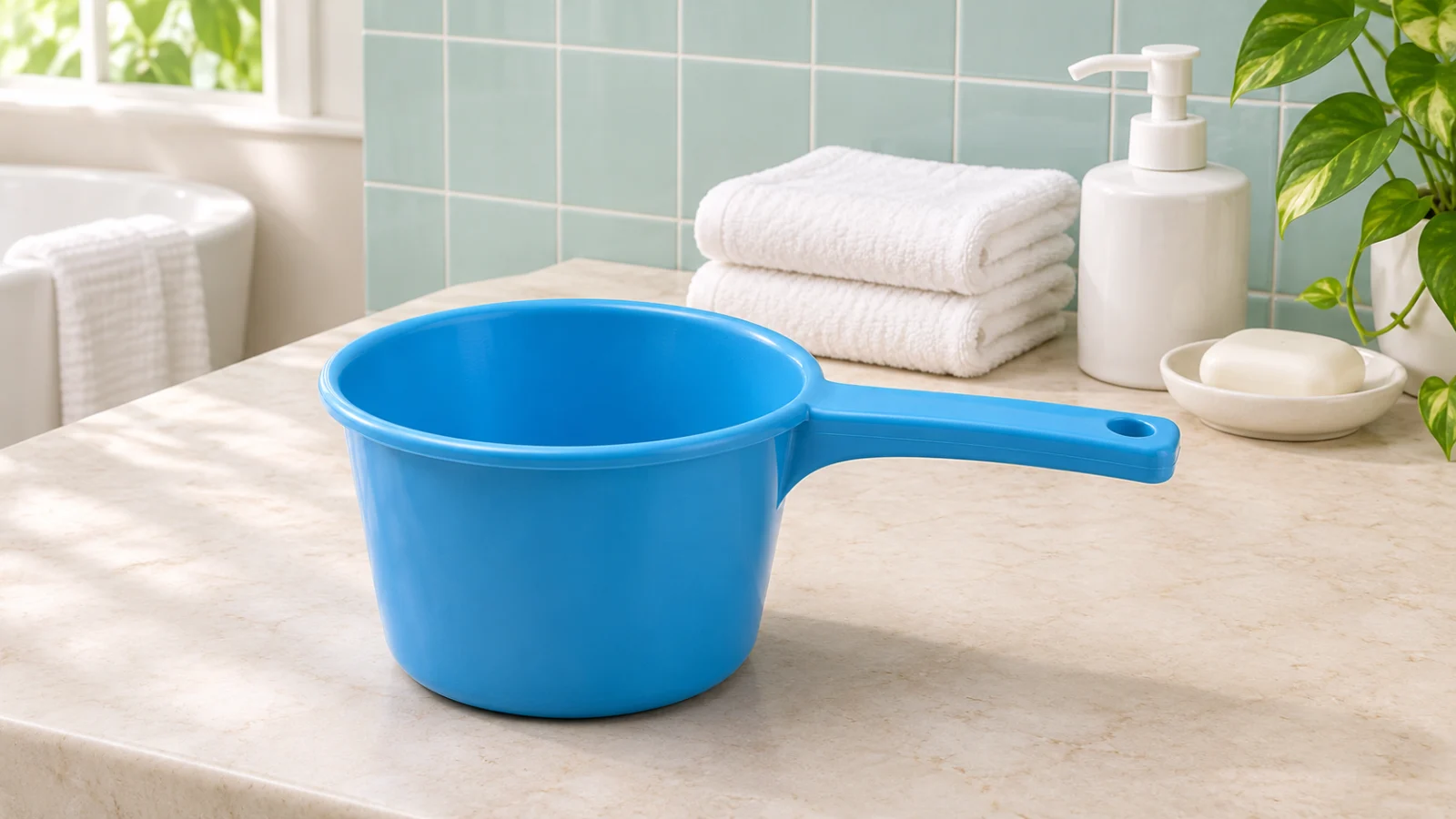
Start with the subject that matches your question. These answers provide general guidance; the instructions supplied with an individual product remain important when deciding how to use and care for it.
Understanding the tabo
Start with the object itself and how it relates to other everyday bathroom essentials.
What is a tabo?
A tabo is a handheld water dipper commonly associated with Filipino households. It has an open container and a handle, allowing a person to scoop and pour water. Designs differ in capacity, shape, handle length, and construction.
The word describes an everyday object rather than one particular brand or model. When comparing products, look at the actual dimensions and intended use instead of assuming that every item described as a tabo is identical.
Is a tabo the same as a bucket?
No. A bucket holds a larger quantity of water, while a tabo transfers a smaller amount by hand. They may be used together, but their roles and handling requirements are different.
Check how the two items fit together. The tabo should be manageable to reach and lift without catching its handle on the bucket rim or a nearby fitting. Their storage positions should also leave access for normal movement and cleaning.
Does every Filipino bathroom use the same setup?
No. Bathroom arrangements vary between households. Space, plumbing, personal preferences, and established routines influence which fixtures and containers are present. A bathroom may combine a shower, handheld spray, bucket, and tabo in different ways.
If you are visiting an unfamiliar home, ask how its setup is intended to be used. The presence of a familiar-looking container does not establish its purpose or mean it should be moved or used without checking.
Can the same dipper be used for different household tasks?
Suitability depends on the product and its previous use. Keep equipment used for bathroom cleaning identifiable rather than treating it as interchangeable with containers intended for other purposes.
Do not assume that an item is appropriate for food preparation or drinking water because it can hold water. Check the manufacturer’s intended-use information. In shared spaces, explain the purpose of each container so that other people do not have to guess.
Choosing a tabo
Compare the features that affect handling and fit, rather than selecting by appearance alone.
Which capacity should I choose?
Choose a capacity that suits the task and remains manageable for the intended user when filled. Water adds weight, so a larger container is not automatically more practical. Consider the empty item’s weight, handle, reach, and available space as well.
Check listed measurements when shopping online. A product photograph may not make size clear, and different variations in the same listing may have different dimensions. Ask the seller when the description leaves an important measurement uncertain.
What should I check on the handle?
Look at finger clearance, handle thickness, accessible edges, and the connection to the body. Check for visible cracks, looseness, or rough areas. A photograph taken from one side may not show the underside or inner edge.
Consider how the handle fits your hand and the intended storage position. A long handle may extend into a walking route, while another design may require an awkward reach. No one shape will feel equally comfortable to every person.
Does a thicker tabo always mean better quality?
Thickness alone does not establish overall quality, a permitted load, or resistance to particular conditions. Material, design, manufacturing, and intended use all contribute to how a product performs.
Evaluate the available product information alongside visible construction and handling needs. If a seller makes a specific performance claim that matters to your choice, ask what it means for that model and whether instructions or supporting information are available.
What should I confirm before ordering online?
Check dimensions, capacity, material information, photographs from several angles, and care instructions. Confirm which size or variation is selected before placing an order, and review the seller’s delivery and return conditions.
Customer comments may suggest useful questions, but they do not replace product instructions or establish a certification. When the item arrives, compare its condition and specifications with the order before putting it into regular use.
Materials and everyday care
Use information for the actual product when deciding how it should be cleaned and maintained.
Can I identify the material from its colour?
Colour, transparency, and appearance are not enough to identify every material property. Check the packaging, markings, or manufacturer’s description rather than inferring an exact material from a photograph.
A material marking is also different from a complete care instruction. It does not answer every question about temperature, cleaning compatibility, or suitable uses. Ask the maker or seller if information relevant to your intended routine is missing.
Can I put a tabo in a dishwasher?
Use a dishwasher only when the product’s instructions explicitly support that method. Do not assume that every plastic or metal dipper can tolerate the same cycle, temperature, or cleaning product.
Check whether instructions apply to every component, including attached handles, finishes, or decorative parts. If dishwasher suitability is not stated, ask the manufacturer or seller and use the recommended alternative rather than testing an uncertain method.
How often should a tabo and bucket be cleaned?
There is no single schedule that covers every household arrangement. Follow the product instructions and consider actual use and condition. Visible soiling or a change in use may require attention outside an established routine.
In a shared bathroom, agree on who handles care and how a problem is reported. A routine should include inspection of the rim, handle, body, and base, as well as attention to the surfaces around the storage position.
When should I replace a tabo?
Consider condition and the manufacturer’s guidance rather than relying on one universal replacement date. Look for leaks, sharp damage, cracking, or a handle connection that no longer feels secure.
Take a damaged item out of use while clarifying what to do next. Do not assume that a repair is suitable or keep using the dipper simply because most of its body appears intact. Contact the maker or seller about an unexpected defect.
Using JLTABO
Understand the scope of the information here and how to contact us about it.
Does JLTABO sell tabo or bathroom products?
This website currently provides informational guides. It does not operate a checkout, accept product orders, or arrange deliveries. Images are used to explain subjects and should not be treated as offers of available stock.
For an order placed with a separate seller, contact that seller about delivery, payment, returns, or product defects. JLTABO cannot access another business’s order records or resolve a transaction carried out elsewhere.
Are the guides instructions for a specific product?
The guides provide general information about comparing, arranging, and caring for everyday essentials. They do not establish the limits or care requirements of every product sold as a tabo or bucket.
Follow the instructions supplied with the item you own. If a question concerns a specialised material, installation, or individual access requirement, obtain advice appropriate to that situation instead of treating a general guide as a product manual.
How can I report an error or ask a question?
Use the contact page and identify the guide you were reading. Describe the unclear statement or factual issue, and include a relevant source when available. Specific details help show what needs attention.
Please do not include passwords, payment details, identity documents, or other sensitive information. A question about a product defect should also be directed to its maker or seller, who can address information specific to that item.
Explore the subject in more detail
Use the dedicated guides when you need a fuller comparison or a practical checklist. Each page focuses on a separate part of choosing and maintaining your setup.