
Find a practical place for your tabo and bucket
Plan storage around access, available space, and everyday cleaning. A useful arrangement makes essentials easy to retrieve and return without crowding the bathroom.
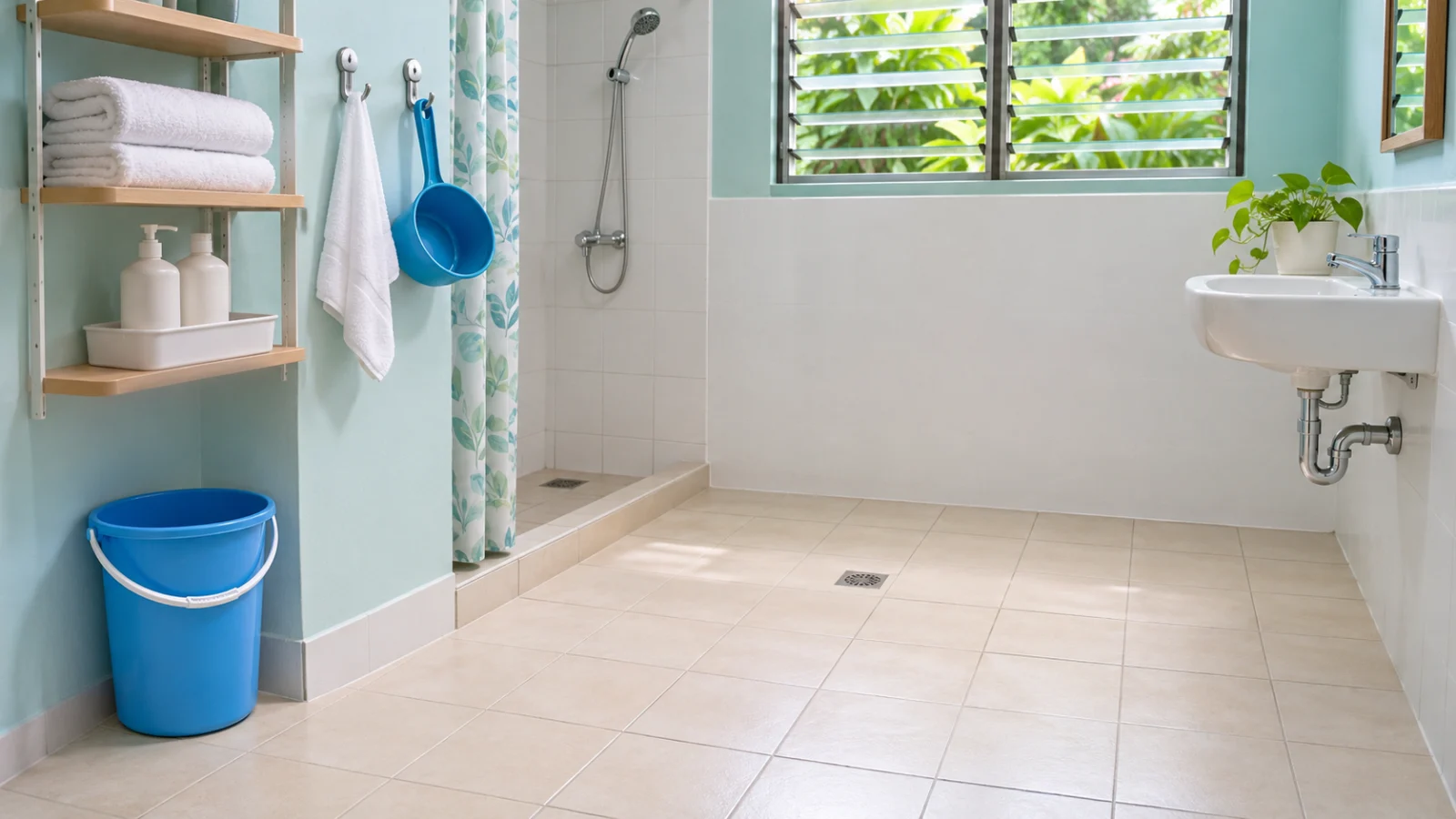
Observe how the room is actually used
Before choosing a storage accessory, look at the way people move through the bathroom. Notice the door opening, the approach to each fixture, and the places where items are temporarily put down. A corner that appears unused may still be needed during an ordinary routine.
Review the space with the tabo and bucket in their normal positions. Check whether a projecting handle catches on clothing or nearby items, whether retrieving the dipper requires moving toiletries, and whether the bucket prevents access to a surface that needs cleaning.
Start by addressing the specific difficulty you observe. Moving one item or removing an unused container may be enough. Adding a shelf or organiser is most useful when it solves a defined problem rather than simply filling available space.
Give the bucket a suitable resting position
Consider the bucket’s base, the surrounding surface, and the room needed to reach it. Avoid a position that depends on balancing the container on an edge or placing it where opening a door will strike it.
Account for the container when filled, not only when empty. Water changes the weight you need to handle. Choose an arrangement that does not require unnecessary lifting or awkward movement to carry out the intended routine.
Leave enough access to inspect and clean around the bucket. If it sits tightly between several objects, moving it may become a task that is repeatedly postponed. A little clearance can make routine maintenance more straightforward.
Do not assume that a shelf, hook, or stand can support a filled container. Follow the stated requirements for the storage fitting and the bucket. Where the intended use is not supported by the instructions, choose another arrangement.
Decide where the tabo belongs between uses
A regular resting place makes the dipper easier to find and return. Consider whether the handle can be reached comfortably and whether taking hold of it requires moving another item first.
The intended position should suit the product’s shape. If it rests on a surface, check the base and available space. If you plan to hang it, confirm that the design supports that use rather than assuming every handle opening is a hanging point.
Think about the handle’s direction. A handle pointing into a narrow route may be caught during movement. Turning or repositioning the item can help, provided the new position still allows practical access and does not make it easy to knock over.
For cleaning and drying, follow the product instructions. Check whether water collects beneath the resting item or inside a storage accessory, and include that area in the cleaning routine.
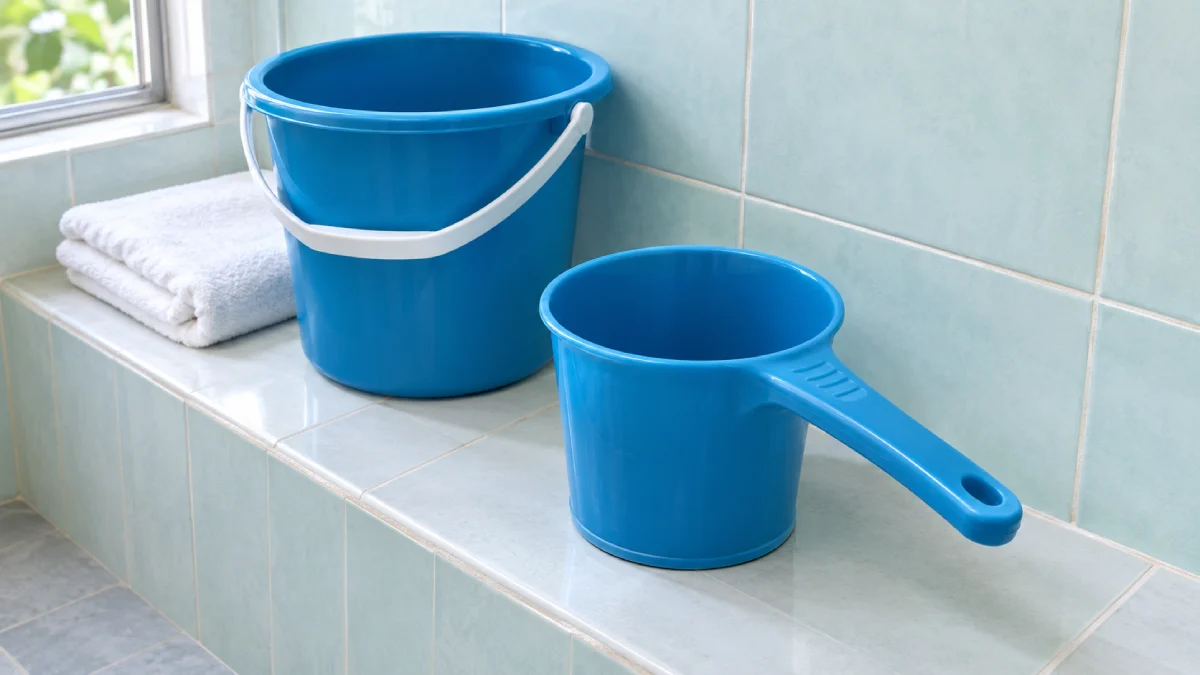
Check hooks and shelves before installing them
Read the storage fitting’s instructions before choosing a location. Look for information about compatible surfaces, installation, permitted loads, and any conditions that affect use.
A fixing intended for one wall surface may not work as described on another. Do not assume that a smooth tile, painted wall, textured finish, and damaged surface can all be treated the same way.
Consider what will be placed on the fitting over time. An organiser may gradually collect more bottles or accessories than originally planned. Keep its stated limits in mind and inspect it for unexpected movement or deterioration.
In a rented property, check what changes are permitted before drilling or applying a permanent fixing. If the installation requires knowledge you do not have, obtain appropriate help instead of improvising around plumbing or electrical fittings.
Keep smaller bathrooms focused on essentials
In a compact room, reducing the number of items can be more effective than adding another organiser. Review what is used regularly, what can be stored elsewhere, and what no longer serves a clear purpose.
Group related toiletries without crowding the surfaces needed for normal use. A compact tray can make a group easier to move, but it should not block access or create a difficult-to-clean space underneath.
Avoid treating every gap as usable storage. Space beside a door, around a fixture, or along a walking route may need to remain open. Compare the benefit of storing an item there with the inconvenience it creates.
The bathroom essentials guide provides a broader checklist for deciding what belongs in the room.
Review the setup with a simple checklist
Check the arrangement during normal use, not only immediately after tidying. Temporary items and changing routines can reveal difficulties that are not obvious when the room is empty.
| Check | Question |
|---|---|
| Access | Can the intended user retrieve and return the tabo without shifting several other objects? |
| Clearance | Are the door opening and ordinary walking routes kept clear? |
| Handle direction | Does the handle project into a place where it is easily caught? |
| Cleaning | Can you move items and reach the surfaces beneath and around them? |
| Fittings | Are hooks and shelves being used within their installation and load requirements? |
| Shared use | Does everyone understand where items belong and what they are intended for? |
Adjust the arrangement when needs change
Storage is not a decision that must remain fixed. A different bucket, a new household member, or a change in cleaning routine may make the previous arrangement less useful.
Review the setup if items are repeatedly left elsewhere, handles are caught during movement, or cleaning requires more effort than expected. These patterns can indicate that the intended storage position is inconvenient.
Make one practical change at a time and observe whether it improves the routine. Follow product instructions, keep the arrangement understandable, and leave room for everyday use as well as maintenance.